I was talking to a friend who, like me, has a background in Geology. I'm more into the palaeogeography and climate change, he's more into rocks from the structural and engineering side. However, we were talking about the sudden spells of stormy weather we're getting just now. My thought was my day would only be complete when someone from Fiends of The Earth or some other eco-nasty group was on tv, spluttering 'global warming' or 'climate change' as is their wont. He absolutely threw me when he said "Bet he" - it's nearly always a he, isn't it - "never even mentions the effects of dust storms from the Sahara."
At that point I stopped in my tracks. I realised a long time ago that desert sand gets everywhere. Usually it's into places you don't want it. Inside cameras, clothes, eyes and ears (look at how camels have evolved to keep it out) plus others too delicate to mention as well ! That fine, silky stuff is in the air around you all the time. Often you don't realise how much there is until the sun starts to set. Then that golden orb suddenly changes to a hazy reddish ball which becomes ever more indistinct as it settles through the last 15 degrees of arc down to the horizon, its rays passing through progressively more and more dust-laden air and their angle becomes more oblique. I'm almost willing to bet that's why camel are so tall - keeps their heads above the worst of the air-borne sand. That and keeping their bodies above the really hot air immediately above the day-time sand would be my best bets.
I found out quite a bit more about its movement 30 years ago from general curiosity. In 1976, that lovely hot dry summer, my car was rained on by a heavy convectional shower (near Pratt's Bottom, of all places. No rude comments please). Drying rapidly, it was covered by fine red blotches. On taking a few samples and testing them I found it was Saharan sand. (Red is the colour of the desert, more or less - oxidised iron, once again). Intrigued by this I actually spent some time with my nose in a book on weather and found out about air streams. It seems that we were being affected by 'cT air' (Tropical continental) from the Sahara. Why they reverse the name compared to the letters is lost on me I'm afraid. It seems that large blobs of air 'sit' over source areas such as the Sahara and take on the temperature and moisture conditions of the source area. After a while they start to stream out. In this case, over us. They take their characteristics with them and modify the weather we would normally get. In the case of 1976, we had that really long spell of hot dry weather. So that fine dust can travel all the way from northern Africa to Britain.
From my studies into the effects of volcanoes I knew a fair amount about the various cooling effects of dust from eruptions. Tambora in 1815 put so much of the stuff into the air that there was no summer and it was known as 'Eighteen Hundred and Frozen To Death'. Turner's paintings with their spectacular skies are about the only real evidence we have of the global spread of that dust since photography didn't exist. Krakatoa in 1883 wasn't quite as devastating but it still caused significant cooling and incredible sunsets. Did you know that the background in 'The Scream' by Munch is that of a sunset affected by volcanic dust, not long after Krakatoa blew its cone away ? I was surprised to find that out. It's one of those stupid little factoids I'm liable to use from time to time. For what it's worth, my favourite factoid of the moment is that Pietro Mascagnia was so proud of his Intermezzo in "Cavaliere Rusticana" that he used to rush up to people whenever he heard it being played and tell them he wrote it. Mind you, I'd be proud to have written anything even half as good at that: it's really stood the test of time. It must be on the radio several times a week.
Dust in the air is also a contributor to the variation in sun's energy reaching the surface of the Earth. At the Equator the sun's rays are close to vertical all the time. They reach the surface and are concentrated into a small area, giving strong heating. At higher latitudes the sun's rays are quite oblique so they have to pass through a lot of atmosphere. On the way through the insolation is reduced significantly by the dust. That plus the diffusion of the sun's rays over larger areas make higher latitudes quite a lot cooler.
Anyway, once I'd thought it through, I wasn't so surprised. On reading up various articles while I've been unwell, I've found that there is an amazingly strong correlation between hurricanes in the Atlantic and the absence of sand blown from the Sahara. When there is no dust there are hurricanes and vice versa. It looks as though these sand storms can blow up in as little as five days and they smother hurricanes by depriving them of the heat and moisture they need to grow. Some years it seems to happen, others not.
Now there's something constructive to build into the analysis and forecasting of hurricanes.
Showing posts with label Sahara. Show all posts
Showing posts with label Sahara. Show all posts
Tuesday, December 12, 2006


Tuesday, October 31, 2006
Siren Sounds Of The Sirocco
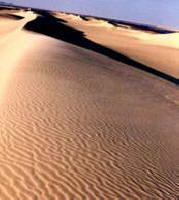
Erg, reg, hamada ? Deserts really tick the boxes for me. Actually, any desert does. Give me creosote bushes plus Joshua trees and I'm ecstatic. However, to give me the real deal, send me where I can hear those sad, soughing, susurrations of the Sirocco singing over the Saharan seif dunes. Most of the people I know think deserts are bleak, desperate places. I just love them (and alliterations, in case you hadn't noticed) !
At first you think they're empty, soul-less places. Very quickly you find out that life has the ability to colonise even the most empty of places. If you don't believe me, put your foot into your boot first thing in the morning without shaking it out first. It's probably going to be ok (scorpion stings only kill you about 39 % of the time (or so I'm told). I just love those extremes. Days are hotter than Hell (If I'm going there and so - after the life I've led, that's a real prospect - I hope that part's true at least. I should just about be able to cope). The nights are more than cold enough to make even a trebly reinforced tungsten steel monkey with doubly insulated underwear flinch. Get up in the cold, harsh steel-gray light of dawn and look at those icy bits on the oasis while you feel the cold strike through you. Two hours later and dehydration will set in if you don't start guzzling Adam's Ale in large quantities. Now that's what I call living. The stars at night are just unbelievable too.
Often the land seems so empty in the daytime. You'd think the nights would be too. Yet, in the dark, your ears seem to pick up so much more. There are all sorts of noises. Crunching, slithering, moaning, howling, you are so aware that there's life out there. Shine a torch out of your tent and see how often ghostly eyes are reflected back at you. Actually, it's quite funny. Light a fire and sit there. Whizzing noisily out of the dark, insects commit suicide at short and remarkably frequent intervals, leaping into the flames from astounding distances.
Mind you, you see some sights too. Whilst doing my bit for my employer in Tunisia, we were doing some research in the desert not too far from the places where they filmed a lot of the Star Wars series. It's very popular with tourists for some reason. Bus loads of tourists descend upon the homes of the trogolodytes and take photos then head back to a hotel with all mod cons. More interestingly, camel trips set off into the desert proper nearby from a camp beside the hotel. They go off and, about 3 hours into the desert, they stop and - suddenly, without any warning, in the searing heat - they are surrounded by local entepreneurs on ancient motorcycles offering them moderately cool coca-cola from satchels on their backs. Surreal. One trip had a lot of Germans, most with the steel-rimmed glasses, the phenomally enormous girths and the lantern jaws. Guess I wouldn't want to be a camel with any of those on top. What was it about straws and camel backs ? Where were their hausfraus I wondered ? One in particular amused me. As they moved along, he would rise up as high as he dared, shade his eyes with his hand in the classical manner whilst his gaze would sweep majestically and ever so slowly across the horizon. So very Lawrence of Arabia. So truly impressive.
Anyway, it's taken a long time to get here. In an earlier post I mentioned dowries. Well, here we go. I was told this story by a colleague whilst in the Sahara. Supposedly, it was told to him by a tribesman from the African Rift valley. The more I think about it, I'm convinced it's probably apocryphal but it's a nice story anyway.
An anthropologist went into the Great Rift Valley in Africa towards the end of the 19th Century. He found a semi-nomadic tribe whose life revolved around cattle and, as anthropologists often do, decided to spend time studying their lives, customs and mores. Over a period of time he became accepted into their tribe, learned their language and became familiar with their ways. Eventually, they were so familiar with him that they would tell him things that, otherwise, they would not discuss with anyone else.
He began to notice the routines of their lives. Men herded the cattle, hunted and fought off the predators such as lions. Women cooked, looked after their houses, brought up the children and spent most of their lives around the villages. Children were educated by the older people and played happily together. However, over time, he noticed that the adult males would spend most their time back in the village at night around one or two fires whenever they returned from their herding and hunting duties. They would drink, gamble and spend a lot of time telling stories about their hunting prowess. Eventually, almost reluctantly at times, they would return to their homes. The women, on the other hand, would spend much of their evenings in laughing, raucous groups often deriding their men, telling stories which were, most definitely, not to their husbands' credit.
As time went on the anthropologist noticed that one man, far more frequently than the others would be first to drift away from the camp-fire sessions and then head for his hut. Nothing was ever said. In terms of wealth, the number of cattle owned by each man, he was not the richest but neither was he the poorest by a long way.
He also noticed that that man's wife rarely ever made any negative comments about her husband - if she ever said anything at all. She was, also, amongst the first of the wives to head for her hut at night. He did notice, however, that the other wives often gave her looks which were almost envious. Again, little was said. Of all of the married women she seemed to be the most relaxed and, probably, just about the happiest in the village.
This observation went on for some considerable time with no significant changes. Eventually, he went to the tribesman and asked why his behaviour and that of his wife were so different to the rest of the tribe. At first, the tribesman was very reluctant to discuss it all. Eventually he took the anthropologist back to his hut and they sat down. The wife brought them drinks and then disappeared.
"The problem is dowries." began the tribesman. "Nearly all of the marriages could be predicted from our childhoods. However, to get your wife you need to go to her father and then negotiate how many cattle you will give as a dowry. Most men begin with an offer of about 6 - 9 cattle, according to the beauty of the girl. The father responds that he will not settle for less than 15. Hard bargaining may go on for many days. Eventually, a price of between 10 and 12 cattle is agreed. Naturally, the bride knows what is paid. After all, the wealth is really her's from then onwards"
"When I went to see my wife's father to make my offer, we sat down. He offered me a drink, as is the custom, and waited for my offer. I looked him in the eye and offered him 16 cattle. His jaw dropped and, in that instant I apologised for insulting him with such a poor offer for his daughter who I had longed for as my wife for so many years. I increased my offer to 18 cattle. He sat there, mouth moving but unable to speak. At that point I made the offer I had in mind before ever I went in to see him. I offered him 22 cattle. He swallowed and accepted. It took less than one hour to reach agreement."
"Why," said the anthropologist "when dowries are about 10 - 12 cattle, did you pay that ? 22 cattle are worth so much. You could have negotiated a much smaller dowry and still she would have been your wife."
"True,'" said the tribesman," but you have seen how wives speak about their husbands, showing little respect or affection, even though they always knew they would probably marry those particular men and wanted to. You have seen men who are often reluctant to return to their homes at night even though they always wanted to marry those particular women. Women truly resent being bargained over even though it is the custom. A bride's standing is reflected in the dowry agreed."
"Now, ask yourself some questions. How does my wife feel, knowing her dowry went upwards without hesitation, not down ? Then ask yourself, how must she feel knowing she has the highest dowry ever given in this village ? Think of her standing in this village and finally ask yourself, how does she feel about her husband ?"
Subscribe to:
Posts (Atom)